About
Jonas Williamsson is a Stockholm-based graphic designer with extensive experience working within the fields of art and culture. His practice is characterised by a project-specific approach, where form emerges through dialogue, research and making.
His practice is concerned with understanding what is already present within a project, and using that as basis for the concept and design. Rather than imposing a form, he develops structures, typographic systems and visual relations that emerge from the material itself and its context. This involves a close reading of content, format and conditions, allowing the work to take shape gradually through its internal logic.
He drew the typeface BIFF, released by Lineto (1999/2022). He graduated from Konstfack in 1999 and co-founded the studio Reala with Samuel Nyholm and Laurent Benner. The studio was active until 2007, working with clients such as Final Home, Vitra, Migros Kulturprozent and Edwin Jeans, while also teaching and exhibiting internationally. Since 2008 he runs his own practice.
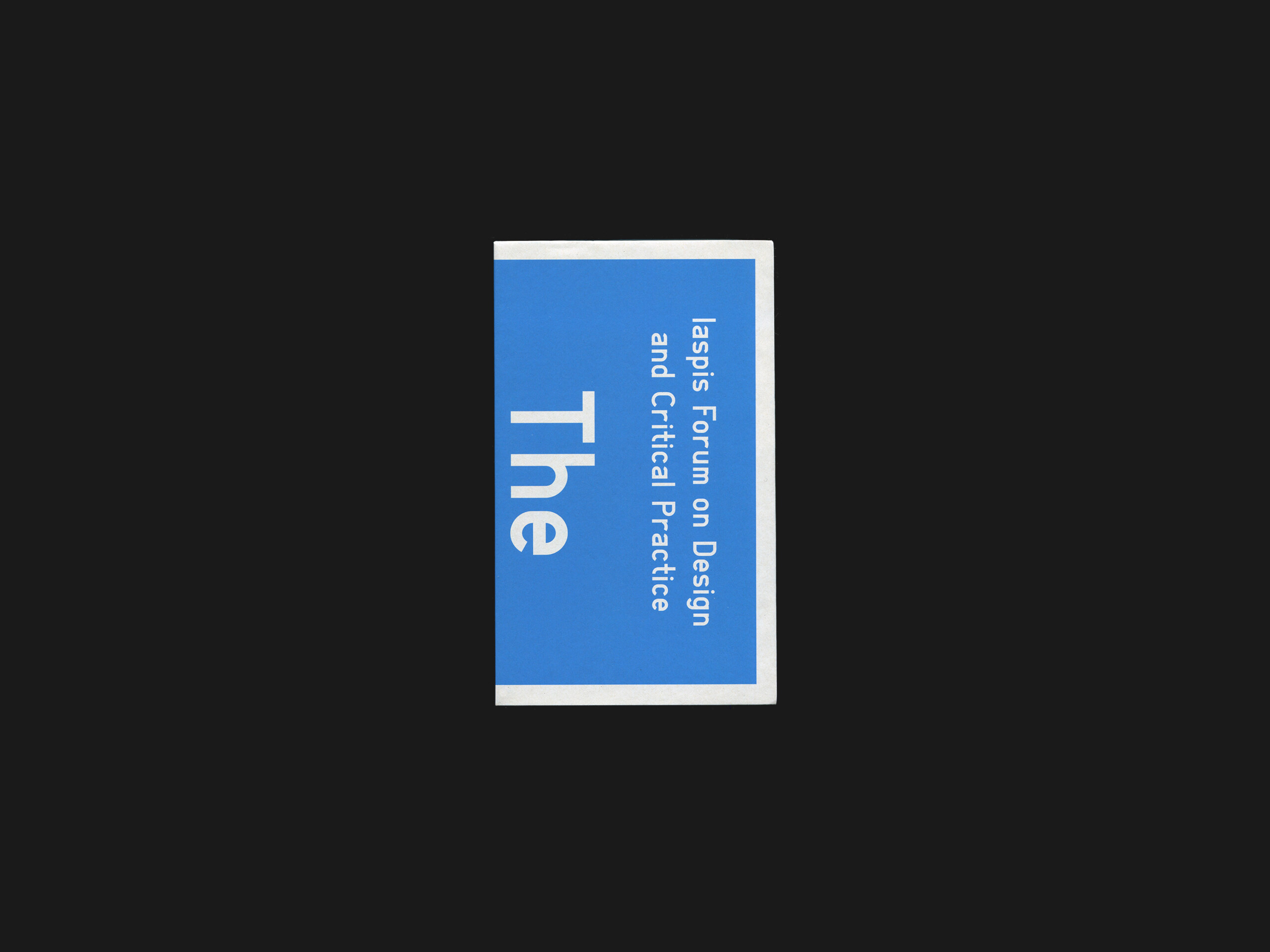
Clients and commissioners include Johanna Gustafsson Fürst, Kim Hiorthøy, Maddie Leach, Märta Thisner, Meike Schalk, Saskia Holmkvist, Åsa Jungnelius, ArkDes, Dansehallerne, Foot Books, Göteborgs Konsthall, IASPIS, Johannes Norlander Arkitektur, Kungl. Konsthögskolan, MDT Moderna Dansteatern, Moderna Museet, Mount Analogue, Null & Void Books, Skissernas Museum, Statens konstråd and the Consulate General of Sweden in Istanbul.
He has taught at ECAL, Gerrit Rietveld Academie, HDK-Valand and Hochschule für Künste Bremen, among others. His work has been exhibited at The Design Museum, London; Museum für Gestaltung, Zurich; Sala de Arte Público Siqueiros, Mexico City; and the Brno Biennial. He has received awards from Svensk Bokkonst, Kolla!/Svenska Tecknare, Årets Bedste Bogarbejde and The New York Art Directors Club.
Contact
Studio Jonas Williamsson
Folkskolegatan 22
117 35 Stockholm, Sweden
+46703240226
studio@jonaswilliamsson.se
Also on Instagram
Bonus Self-interview (2023)
You have recently turned 50 and have now been in the business for more than 25 years. How are you doing today?
I am good, how are you?
What did we decide about this interview?
We thought we would converse while listening to this documentary about John Cage, that the interview would be based on its duration.
Cage speaks about time, space, and aging. What are your thoughts on growing older?
There is something relative about aging, it simply is going on, no matter what we want of it. We have always, and will forever be in this state. There’s an expectation that age will eventually gain a new meaning or gravity, and sometimes I sense that. I remember when mainstream advertising stopped addressing me and perhaps something similar is happening now, but in society, expectations fall away. It is both a relief and a bit depressing.
He also describes stepping aside as a composer, letting the work emerge more directly between sound and listener. How does that resonate with your own practice?
I’ve been trying to move away from myself in the work. Not completely, but at least its dominance. I had assumed that age would naturally take care of that, that the ego would recede on its own, but it doesn’t seem to work like that. So lately I’ve been thinking more consciously about how to construct a working situation where the work can unfold with a certain independence. Not as expression, or communication in a direct sense, but as something that can exist between material, form and context. In that sense, maybe closer to what Cage describes, where one is not only composing, but also listening. At the same time, this might also be a way of continuing to work without becoming too occupied with one’s own position or trajectory. To stay with the work itself, and the pleasure of doing it.
Tell us more.
For quite some time I’ve been interested in limiting my practice, a kind of framework that applies to all work. One principle has been to focus only on what is already within a project, adding nothing else. Using materials and models as a way to be frugal, but also out of the conviction that creativity arises from limitation. Lately, perhaps as a complement, I’ve become more interested in conversation as a method to both delimit and expand a project. Often one can reach a deeper level if the conversation arrives at a state where all participants are free in mind and speech. Like Cage, I’m drawn to ideas that generate certain outcomes.
What kind of ideas?
Well, in a similar way, I’ve grown increasingly weary of a hard-edged approach. I’m not that inspired by the political sphere at the moment, seemingly fueled by algorithms and caught in a narrow vision. Lars Norén comes to mind in this regard, and how his work at times could be understood in relation to what Jürgen Habermas calls Communicative Action. That is, seeking conversation as a way of understanding, not necessarily to share a position, persuade, or promote an idea, but to engage with the other. Perhaps that was part of what informed Norén in some of his more criticized works. Why engage with such questions? Perhaps because they do not disappear simply because we would prefer them to…
Actually, the documentary is finished now. Should we still continue?
Let’s continue another time.
Ok, thank you for the chat.
Thanks for reading.